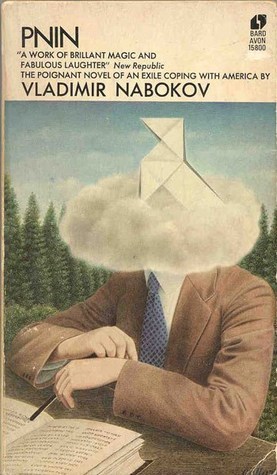
written alongside [[Lolita]]—interesting contrasts of pnin and hh. victor wind foreshadows the [[Pale Fire]] exiling of a king—also similar narrator motif
We first meet him on the train, because his life is one of movement, often involuntary. And we meet him on the wrong train because he is a fool.
“A man of great moral courage, a pure man, a scholar and a staunch friend, serenely wise, faithful to a single love, he never descends from a high plane of life characterised by authenticity and integrity. But handicapped and hemmed in by his incapability to learn a language, he seems a figure of fun to many an average intellectual...”
Chapter One
All our friend's lectures, including sundry ones he gave out of town, were edited by one of the younger members of the German Department. The procedure was somewhat complicated. Professor Pnin laboriously translated his own Russian verbal flow, teeming with idiomatic proverbs, into patchy English. This was revised by young Miller. Then Dr Hagen's secretary, a Miss Eisenbohr, typed it out. Then Pnin deleted the passages he could not understand. Then he read it to his weekly audience. He was utterly helpless without the prepared text, nor could he use the ancient system of dissimulating his infirmity by moving his eyes up and down--snapping up an eyeful of words, reeling them off to his audience, and drawing out the end of the sentence while diving for the next.
He found himself in a damp, green, purplish park, of the formal and funereal type, with the stress laid on sombre rhododendrons, glossy laurels, sprayed shade trees and closely clipped lawns; and hardly had he turned into an alley of chestnut and oak, which the bus driver had curtly told him led back to the railway station, than that eerie feeling, that tingle of unreality overpowered him completely. Was it something he had eaten? That pickle with the ham? Was it a mysterious disease that none of his doctors had yet detected? My friend wondered, and I wonder, too.
I do not know if it has ever been noted before that one of the main characteristics of life is discreteness. Unless a film of flesh envelops us, we die. Man exists only insofar as he is separated from his surroundings. The cranium is a spacetraveller's helmet. Stay inside or you perish. Death is divestment, death is communion. It may be wonderful to mix with the landscape, but to do so is the end of the tender ego.
The avalanche stopping in its tracks a few feet above the cowering village behaves not only unnaturally but unethically.
Chapter Two
'We'll get you an electric heater,' Joan told Pnin confidentially, as she offered him some olives.
'What make heater?' asked Pnin suspiciously.
'That remains to be seen. Any other complaints?'
'Yes--sonic disturbance,' said Pnin. 'I hear every, every sound from downstairs, but now it is not the place to discuss it, I think.'
I plan to retire soon, and till then I prefer to remain in the musty but familiar hole.
He did something fatal to his new heater and gloomily said never mind, it would soon be spring now.
Laurence, on going up to his study one day, a secret and sacred lair cunningly carved out of the attic, was incensed to find the mellow lights on and fat-naped Pnin braced on his thin legs serenely browsing in a corner: 'Excuse me, I only am grazing,' as the gentle intruder (whose English was growing richer at a surprising pace) remarked, glancing over the higher of his two shoulders;
There are some beloved women whose eyes, by a chance blend of brilliancy and shape, affect us not directly, not at the moment of shy perception, but in a delayed and cumulative burst of light when the heartless person is absent, and the magic agony abides, and its lenses and lamps are installed in the dark. Whatever eyes Liza Pnin, now Wind, had, they seemed to reveal their essence, their precious-stone water, only when you evoked them in thought, and then a blank, blind, moist aquamarine blaze shivered and stared as if a spatter of sun and sea had got between your own eyelids. Actually her eyes were of a light transparent blue with contrasting black lashes and bright pink canthus, and they slightly stretched up templeward, where a set of feline little lines fanned out from each. She had a sweep of dark brown hair above a lustrous forehead and a snow-and-rose complexion, and she used a very light red lipstick, and save for a certain thickness of ankle and wrist, there was hardly a flaw to her full-blown, animated, elemental, not particularly well-groomed beauty.
He went on with his Slavic studies, she with her psychodramatics and her lyrical ovipositing, laying all over the place like an Easter rabbit, and in those green and mauve poems--about the child she wanted to bear, and the lovers she wanted to have, and St Petersburg (courtesy Anna Akhmatov)--every intonation, every image, every simile had been used before by other rhyming rabbits.
Pnin of course would have given her a divorce as readily as he would his life, with the wet stems cut and a bit of fern, and all of it wrapped up as crisply as at the earth-smelling florist's when the rain makes grey and green mirrors of Easter day;
On the third evening of the voyage, having remained in the lounge long after Liza had gone to sleep, he cheerfully accepted a game of chess proposed by the former editor of a Frankfurt newspaper, a melancholy baggy-eyed patriarch in a turtle-neck sweater and plus fours. Neither was a good player; both were addicted to spectacular but quite unsound sacrifices of pieces; each was over-anxious to win;
Be just. The prisoner has always the last word; it is his right. Even the Nazis admit it.
And at last, when the great statue arose from the morning haze where, ready to be ignited by the sun, pale, spellbound buildings stood like those mysterious rectangles of unequal height that you see in bar graph representations of compared percentages (natural resources, the frequency of mirages in different deserts)
Why not leave their private sorrows to people? Is sorrow not, one asks, the only thing in the world people really possess?
Eric is one hard emotional block in his attitude toward Victor. I don't know how many times the boy must have killed him in his dreams. And, with Eric, verbalization--I have long noticed--confuses problems instead of clarifying them. He is a very difficult person. What is your salary, Timofey?
In one sinuous tendril-like movement, the intelligent animal climbed up to the brim of a drinking fountain and, as Pain approached, thrust its oval face toward him with a rather coarse spluttering sound, its cheeks puffed out
When Joan with a bagful of provisions, two magazines, and three parcels, came home at a quarter past five, she found in the porch mailbox a special-delivery airmail letter from her daughter. More than three weeks had elapsed since Isabel had briefly written her parents to say that, after a honeymoon in Arizona, she had safely reached her husband's home town. Juggling with her packages, Joan tore the envelope open. It was an ecstatically happy letter, and she gulped it down, everything swimming a little in the radiance of her relief. On the outside of the front door she felt, then saw with brief surprise, Pnin's keys, like a bit of his fondest viscera, dangling with their leathern case from the lock; she used them to open the door, and as soon as she had entered she heard, coming from the pantry, a loud anarchistic knocking--cupboards being opened and shut one after the other. She put her bag and parcels down on the sideboard in the kitchen and asked in the direction of the pantry: 'What are you looking for, Timofey?' He came out of there, darkly flushed, wild-eyed, and she was shocked to see that his face was a mess of unwiped tears. 'I search, John, for the viscous and sawdust,' he said tragically. 'I am afraid there is no soda,' she answered with her lucid Anglo-Saxon restraint. 'But there is plenty of whisky in the dining-room cabinet. However, I suggest we both have some nice hot tea instead.' He made the Russian' relinquishing' gesture. 'No, I don't want anything at all,' he said, and sat down at the kitchen table with an awful sigh. She sat down next to him and opened one of the magazines she had bought. 'We are going to look at some pictures, Timofey.' 'I do not want, John. You know I do not understand what is advertisement and what is not advertisement.' 'You just relax, Timofey, and I'll do the explaining. Oh, look--I like this one. Oh, this is very clever. We have here a combination of two ideas--the Desert Island and the Girl in the Puff. Now, look, Timofey--please'--he reluctantly put on his reading glasses--'this is a desert island with a lone palm, and this is a bit of broken raft, and this is a shipwrecked mariner, and this is the ship's cat he saved, and this here, on that rock--' 'Impossible,' said Pnin. 'So small island, moreover with palm, cannot exist in such big sea.' 'Well, it exists here.' 'Impossible isolation,' said Pnin. 'Yes, but--Really, you are not playing fair, Timofey. You know perfectly well you agree with Lore that the world of the mind is based on a compromise with logic.' 'I have reservations,' said Pnin. 'First of all, logic herself--' 'All right, I'm afraid we are wandering away from our little joke. Now, you look at the picture. So this is the mariner, and this is the pussy, and this is a rather wistful mermaid hanging around, and now look at the puffs right above the sailor and the pussy.' 'Atomic bomb explosion,' said Pnin sadly. 'No, not at all. It is something much funnier. You see, these round puffs are supposed to be the projections of their thoughts. And now at last we are getting to the amusing part. The sailor imagines the mermaid as having a pair of legs, and the cat imagines her as all fish.' 'Lermontov,' said Pnin, lifting two fingers, 'has expressed everything about mermaids in only two poems. I cannot understand American humour even, when I am happy, and I must say--' He removed his glasses with trembling hands, elbowed the magazine aside, and, resting his head on his arm, broke into muffled sobs.
'I haf nofing,' wailed Pnin between loud, damp sniffs, 'I haf nofing left, nofing, nofing!'
Chapter Three
During the eight years Pnin had taught at Waindell College he had changed his lodgings--for one reason or another, mainly sonic--about every semester. The accumulation of consecutive rooms in his memory now resembled those displays of grouped elbow chairs on show, and beds, and lamps, and inglenooks which, ignoring all space-time distinctions, commingle in the soft light of a furniture store beyond which it snows, and the dusk deepens, and nobody really loves anybody.
With age, however, Pnin had become choosy. Pretty fixtures no longer sufficed. Waindell was a quiet townlet, and Waindellville, in a notch of the hills, was yet quieter; but nothing was quiet enough for Pnin. There had been, at the start of his life here, that studio in the thoughtfully furnished College Home for Single Instructors, a very nice place despite certain gregarious drawbacks ('Ping-pong, Pnin?' 'I don't any more play at games of infants'), until workmen came and started to drill holes in the street--Brainpan Street, Pningrad--and patch them up again, and this went on and on, in fits of shivering black zigzags and stunned pauses, for weeks, and it did not seem likely they would ever find again the precious tool they had entombed by mistake.
For a moment he struggled with himself; he still needed the volume; but kindly Pnin sympathized too much with the passionate clamour of another (unknown) scholar not to go back for the stout and heavy tome: It was Volume 18--mainly devoted to Tolstoyana--of Sovetskiy Zolotoy Fond Literaturi (Soviet Gold Fund of Literature), Moskva-Leningrad, 1940.
it went up a slope, then turned sharply and wandered down toward a routine smell of potato chips and the sadness of balanced meals.
Before leaving the library, he decided to look up the correct pronunciation of 'interested', and discovered that Webster, or at least the battered 1930 edition lying on a table in the Browsing Room, did not place the stress accent on the third syllable, as he did. He sought a list of errata at the back, failed to find one, and, upon closing the elephantine lexicon, realized with a pang that he had immured somewhere in it the index card with notes that he had been holding all this time. Must now search and search through 2, 500 thin pages, some torn! On hearing his interjection, suave Mr Case, a lank, pink-faced librarian with sleek white hair and a bow-tie, strolled up, took up the colossus by both ends, inverted it, and gave it a slight shake, whereupon it shed a pocket comb, a Christmas card, Pnin's notes, and a gauzy wraith of tissue paper, which descended with infinite listlessness to Pnin's feet and was replaced by Mr Case on the Great Seals of the United States and Territories.
Chapter Four
'Abdication! One-third of the alphabet!' coldly quipped the King, with the trace of an accent. 'The answer is no. I prefer the unknown quantity of exile.'
At two, Victor did not make little spiral scribbles to express buttons or port-holes, as a million tots do, why not you? Lovingly he made his circles perfectly round and perfectly closed. A three-year-old child, when asked to copy a square, shapes one recognizable corner and then is content to render the rest of the outline as wavy or circular; but Victor at three not only copied the researcher's (Dr Liza Wind's) far from ideal square with contemptuous accuracy but added a smaller one beside the copy.
And at six, Victor already distinguished what so many adults never learn to see--the colours of shadows, the difference in tint between the shadow of an orange and that of a plum or of an avocado pear.
One way to do it might be by making the scenery penetrate the automobile. A polished black sedan was a good subject, especially if parked at the intersection of a tree-bordered street and one of those heavyish spring skies whose bloated grey clouds and amoeba-shaped blotches of blue seem more physical than the reticent elms and evasive pavement. Now break the body of the car into separate curves and panels; then put it together in terms of reflections. These will be different for each part: the top will display inverted trees with blurred branches growing like roots into a washily photographed sky, with a whalelike building swimming by--an architectural afterthought; one side of the hood will be coated with a band of rich celestial cobalt; a most delicate pattern of black twigs will be mirrored in the outside surface of the rear window; and a remarkable desert view, a distended horizon, with a remote house here and alone tree there, will stretch along the bumper.
This is not his best book but O. K., O. K., I will take it.
He pursed his lips, He opened them--but said nothing. In silence he ate his vanilla ice-cream, which contained no vanilla and was not made of cream.
Chapter Five
They were still young, loved each other with a sort of old-world simplicity and integrity very soothing to observe, and instead of populating their country place with children and grandchildren, they collected every even-year summer, elderly Russians (Cook's fathers or uncles, as it were); on odd--year summers they would have amerikantsi (Americans), Alexandr's business acquaintances or Susan's relatives and friends.
I never cared much for Bolotov and his philosophical works, which so oddly combine the obscure and the trite; the man's achievement is perhaps a mountain--but a mountain of platitudes;
he cautiously turned into a sandy avenue, bordered with wild lupins, and, sitting very straight, stiffly clutching the steering-wheel as if he were a farmer more used to his tractor than to his car, entered, at ten miles an hour and in first gear
Pnin slowly walked under the solemn pines. The sky was dying.' He did not believe in an autocratic God. He did believe, dimly, in a democracy of ghosts. The souls of the dead, perhaps, formed committees, and these, in continuous session, attended to the destinies of the quick.
Chapter Six
For Pnin, who was totally unaware of his protector's woes, the new Fall Term began particularly well: he had never had so few students to bother about, or so much time for his own research. This research had long entered the charmed stage when the quest overrides the goal, and a new organism is formed, the parasite so to speak of the ripening fruit. Pnin averted his mental gaze from the end of his work, which was so clearly in sight that one could make out the rocket of an asterisk, the flare of a 'sic!' This line of land was to be shunned as the doom of everything that determined the rapture of endless approximation. Index cards were gradually loading a shoe box with their compact weight. The collation of two legends; a precious detail in manners or dress; a reference checked and found to be falsified by incompetence, carelessness, or fraud; the spine thrill of a felicitous guess; and all the innumerable triumphs of bezkoristniy (disinterested, devoted) scholarship--this had corrupted Pnin, this had made of him a happy, footnote-drugged maniac who disturbs the book mites in a dull volume, a foot thick, to find in it a reference to an even duller one.
Outwardly, Roy was an obvious figure. If you drew a pair of old brown loafers, two beige elbow patches, a black pipe, and two baggy eyes under heavy eyebrows, the rest was easy to fill out.
Tom thinks that the best method of teaching anything is to rely on discussion in class, which means letting twenty young blockheads and two cocky neurotics discuss for fifty minutes something that neither their teacher nor they know.
It was a fair fall night, velvet below, steel above. Joan asked: 'You're sure you don't want us to give you a lift?' 'It's a ten-minute walk. And a walk is a must on such a wonderful night.' The three of them stood for a moment gazing at the stars. 'And all these are worlds,' said Hagen. 'Or else,' said Clements with a yawn, 'a frightful mess. I suspect it is really a fluorescent corpse, and we are inside it.'
Chapter Seven
It was one of those rough, gusty, and lustrous mornings in St Petersburg, when the last transparent piece of Ladoga ice has been carried away to the gulf by the Neva, and her indigo waves heave and lap the granite of the embankment, and the tugboats and huge barges, moored along the quay, creak and scrape rhythmically, and the mahogany and brass of anchored steam yachts shine in the skittish sun.
I am not handsome, I am not interesting, I am not talented. I am not even rich. But Lise, I offer you everything I have, to the last blood corpuscle, to the last tear, everything. And, believe me, this is more than any genius can offer you because a genius needs to keep so much in store, and thus cannot offer you the whole of himself as I do. I may not achieve happiness, but I know I shall do everything to make you happy. I want you to write poems. I want you to go on with your psychotherapeutic research--in which I do not understand much, while questioning the validity of what I can understand. Incidentally, I am sending you under separate cover a pamphlet published in Prague by my friend Professor Chateau, which brilliantly refutes your Dr Halp's theory of birth being an act of suicide on the part of the infant. I have permitted myself to correct an obvious misprint on page 48 of Chateau's excellent paper. I await your' (probably 'decision', the bottom of the page with the signature had been cut off by Liza).
I am so constituted that I absolutely must gulp down the juice of three oranges before confronting the rigours of day.